
The deal had everything going for it.
Strong relationship. Genuine need. The right solution. Six months of careful work by a Business Developer who had done almost everything right. And then, at the point where a decision should have been made, the customer said they needed more time.
Three months later: still more time.
Six months after that: the project was deprioritised.
It did not go to a competitor. It went nowhere.
No decision is the most expensive outcome in consultative sales. Not losing to the competition. Not a deal that collapses. A deal that simply stops. And in my experience of assessing and coaching commercial professionals across major B2B organisations, the primary reason is almost always the same: nobody helped the customer properly understand what it cost them to stay exactly as they were.
This is the cost of inaction. Understanding how to surface it, quantify it, and use it responsibly is one of the most critical capabilities in consultative selling.
Why it matters more in consultative sales than anywhere else
In transactional sales, the customer comes to you with a defined need and a budget attached. They know what they want. The cost of not buying is already clear to them.
In consultative sales, the starting point is different. You are often working with a problem the customer is tolerating, a risk they have not fully examined, or an opportunity they have not yet quantified. The need is latent. The urgency is not obvious. And the default position for any senior executive under pressure is to deprioritise anything that does not have a clear and immediate cost attached to ignoring it.
Your job in consultative selling is not just to present a solution. It is to help the customer understand what it costs them, commercially, operationally, and personally, to leave the problem unsolved. Without that understanding there is no urgency. Without urgency there is no decision. Without a decision, the deal stalls.
The key issues most sellers run into
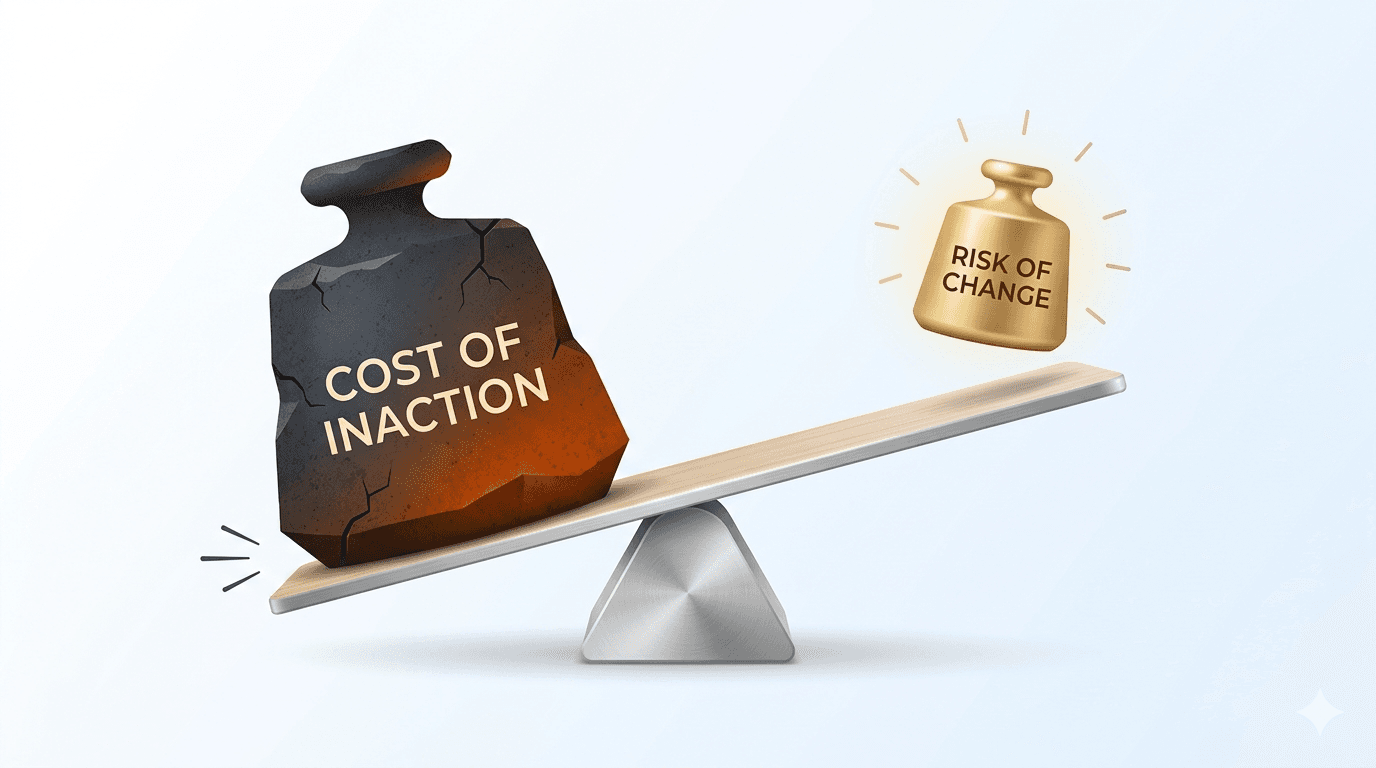
The status quo bias is the first. Psychologically, change is risky. Staying still feels safe. Even when the current situation is genuinely costly, the perceived risk of change often outweighs the perceived cost of inaction in the customer’s mind. A consultative seller’s job is to shift that calculation, not by manufacturing fear, but by helping the customer see the real numbers clearly.
Seller discomfort is the second. Asking a customer what it costs them to not solve a problem feels confrontational to many sellers. It can feel like a pressure tactic. This discomfort means the conversation either gets skipped entirely, or handled so softly that the customer does not feel the weight of it.
Vague answers are the third. When sellers do ask, customers often respond with general language. It is costing us efficiency. We are losing some revenue. It is causing friction. These answers feel like progress but they are not. They do not create urgency because they do not put a specific number to a specific problem.
Missing the personal cost is the fourth. Commercial costs matter. Revenue lost, efficiency wasted, margin eroded. But in my experience they are rarely the most powerful motivator. The personal cost, the reputational risk for the person sponsoring the status quo, the career implications of a decision that goes wrong, the daily frustration of managing a problem that should have been resolved, is often what creates real urgency. Most sellers never ask about it.
The multi-stakeholder problem is the fifth. In a complex buying environment, the cost of inaction means something different to each person involved. A single version of the cost delivered to one person is not enough.
What happens to deals when you do not address it
Deals stall. The close date moves. Every pipeline review shows the same opportunity at the same stage with a new expected date three months out. The customer is not saying no. They are saying not now. And not now, left unaddressed, becomes never.
Price becomes the only lever. When there is no urgency, the customer’s only tool for creating movement is to ask for a discount. A clearly quantified cost of inaction removes this dynamic entirely. The decision justifies itself.
You lose to inertia, not to a competitor. The sellers who win complex B2B deals consistently are not always the ones with the best product. They are often the ones who helped the customer understand most clearly why staying still was not a viable option.
Five things to do
Ask about the cost before you mention a solution. The sequence matters. What does it cost you to leave this as it is needs to come before here is what we can do about it. Once the solution is on the table, the conversation shifts to price and features.
Push past vague answers. When a customer says it is affecting our efficiency, follow with: how much time is that costing your team weekly? Vague answers do not create urgency. Specific numbers do.
Quantify in their metrics, not yours. Every organisation has the measures it cares about. Revenue per head. Customer retention. Time to close. The cost of inaction needs to be expressed in the language the customer’s leadership team uses.
Find the personal cost. Once the commercial cost is established, ask one more question: who in your organisation is most affected by this continuing? Then ask that person directly what it means for them. This is not manipulation. The personal cost is real. Helping someone articulate it is a genuine service, and it is often the conversation that creates the urgency that commercial numbers alone cannot.
Revisit and reinforce throughout the process. The cost of inaction is not a box to tick in discovery. Given what we agreed the cost of this is, how does that affect your thinking on timing brings the urgency back without pressure.
Five things to avoid
Raising it before trust is established. The cost of inaction question asked too early sounds like a sales tactic. It needs to come after real discovery, when the relationship can carry the weight of a direct question.
Accepting I would need to look into that without a follow-up. Agree a date to revisit it. Make it a shared task.
Using industry statistics instead of their specific numbers. Generic data establishes context but it does not create urgency. Their number, in their language, is the only one that creates a reason to act.
Focusing only on financial cost. Operational disruption, reputational risk, and personal career implications are often more visceral. Do not leave them out of the conversation.
Mentioning it once and moving on. The cost of inaction, established in one meeting, fades. It needs to be referenced at each significant stage.
What the data tells us about sellers today
The MyAcumen data makes the gap visible. When it comes to quantifying the business impact of a problem, only 24% of commercial professionals score as strong. When it comes to quantifying the expected benefits of a solution, that figure rises to 53%. Most sellers are twice as likely to build the case for the gain as they are to build the case for staying still.
Research from Kahneman and Tversky shows why that is the wrong way round: the fear of loss carries roughly twice the psychological weight of an equivalent potential gain.
Your customers are not choosing between your solution and a competitor. They are choosing between your solution and doing nothing. The sellers who win consistently in consultative environments are not always the ones with the strongest ROI story. They are the ones who made the cost of inaction more uncomfortable than the risk of change.
If you want to know where your Value Case Building capability actually sits, the MyAcumen assessment gives you a specific picture across skills, motivation, personality, and how others experience you. Find the right assessment for your role