
I was reviewing a discovery call with James a few years ago. He was a solid Business Developer. Prepared questions, good rapport, comfortable with silence. The customer had engaged genuinely throughout. By any standard measure, it had gone well.
But when I asked him what he thought the customer would do differently after that meeting, he paused. He could tell me what he had learned. He could not tell me what the customer had learned.
That gap is the one I see most consistently in consultative sellers at every level. Not the absence of skill. The absence of one specific type of question.
Most sellers have been taught to ask. Very few have been taught to challenge.
If you have spent any time in B2B sales, you have probably encountered SPIN. Neil Rackham’s research gave the industry something it genuinely needed: a structured way to think about discovery. Situation, Problem, Implication, Need-payoff. Gather the facts, surface the problem, explore the consequences, help the customer articulate the value of solving it. Most experienced consultative sellers have internalised some version of this, even if they have never read the book.
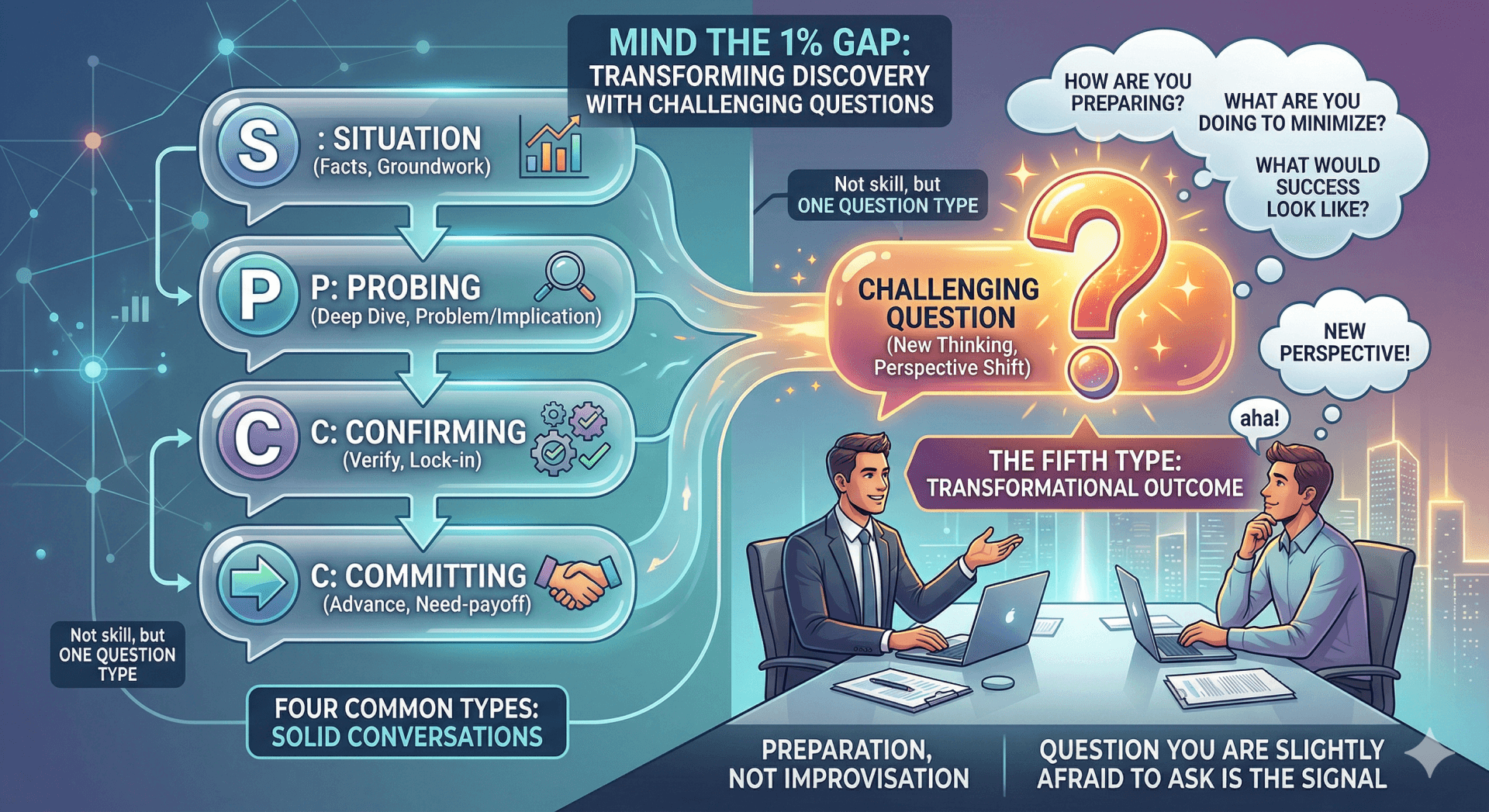
In practice, I have observed five distinct types of question in a consultative conversation. Four of them map directly onto SPIN. The fifth is where most sellers leave the most value behind.
Sales Questioning Model
Situation questions establish the facts. Who, what, where, when, how much, why now. This is SPIN’s S. Essential groundwork, but low value if overused. The customer has answered these before, often many times.
Probing questions dig deeper. Tell me more. Help me understand. Walk me through that. They also get personal: how does that feel? Mirroring what you heard back. This is where SPIN’s Problem and Implication questions live, surfacing the issue and exploring its consequences. Most good sellers spend most of their time here, and it produces solid conversations.
Confirming questions lock in what you have heard before moving forward. So if I understand correctly… You said this was costing you X, did I get that right? No direct equivalent in SPIN, but critical. Miss this step and you build a proposal on assumptions neither party has verified.
Committing questions advance the deal. If we do this, will you do that? Can we schedule that by Friday? SPIN’s Need-payoff question lives here, securing agreement on the value of solving the problem and gaining the next commitment. Each one moves something forward.
These four, used with any consistency, produce a competent consultative conversation. The customer feels heard. You gather what you need. The meeting ends well.
But something is missing. The fifth type is what I call Challenging questions.
Their job is different from all the others. They do not gather facts, dig deeper into known problems, confirm understanding, or gain commitment. They raise awareness the customer did not have before the conversation started. New thinking. A perspective they had not considered. A question that makes them pause and look at their situation differently.
How are you preparing for… What are you doing to minimise the risk of… How will you be sure to… What would success actually look like for…
SPIN gestures towards this in the Implication question, asking what happens if the problem goes unsolved. Challenging questions go further. They do not just explore existing consequences. They introduce a dimension the customer was not thinking about at all.
This is precisely what separates the Consultant type in Forrester’s research from every other seller profile. Not technique. Not rapport. Not the ability to ask good questions. The ability to shift how someone sees their own situation before the solution is ever mentioned.
Why most sellers skip it
Challenging questions require something the other four do not: a point of view formed before the meeting starts. You cannot improvise a genuine challenge. You need to know enough about the customer’s industry, their commercial pressures, their likely blind spots, to identify the gap worth introducing.
That means preparation. Real preparation, not reviewing the account history or rehearsing the pitch, but forming a perspective on something specific about their situation that they may not have examined recently.
Most sellers skip this step because the other four question types produce a meeting that feels productive. The customer engages. Notes are taken. Actions are agreed. The seller leaves satisfied.
The problem is that nothing changed for the customer. They left thinking what they already thought. The seller confirmed their existing view rather than expanding it.
The shift is small. The difference is significant.
Before your next significant discovery meeting, write down one challenging question. Just one. It should start with how are you or what are you doing to. It should be specific to their industry or situation. And it should make you slightly uncomfortable to ask, because it implies the customer may not have thought something through.
That discomfort is the signal. It is the question worth preparing.
James took this seriously. Two months later he told me the single change that had made the most difference to his customer conversations was not a new technique or a new structure. It was the habit of arriving with one question he was slightly afraid to ask.
That is the 1% gap. It is not about working harder. It is about preparing one thing differently.
To understand your capabilities in consultative selling get your own assessment, or assess your team