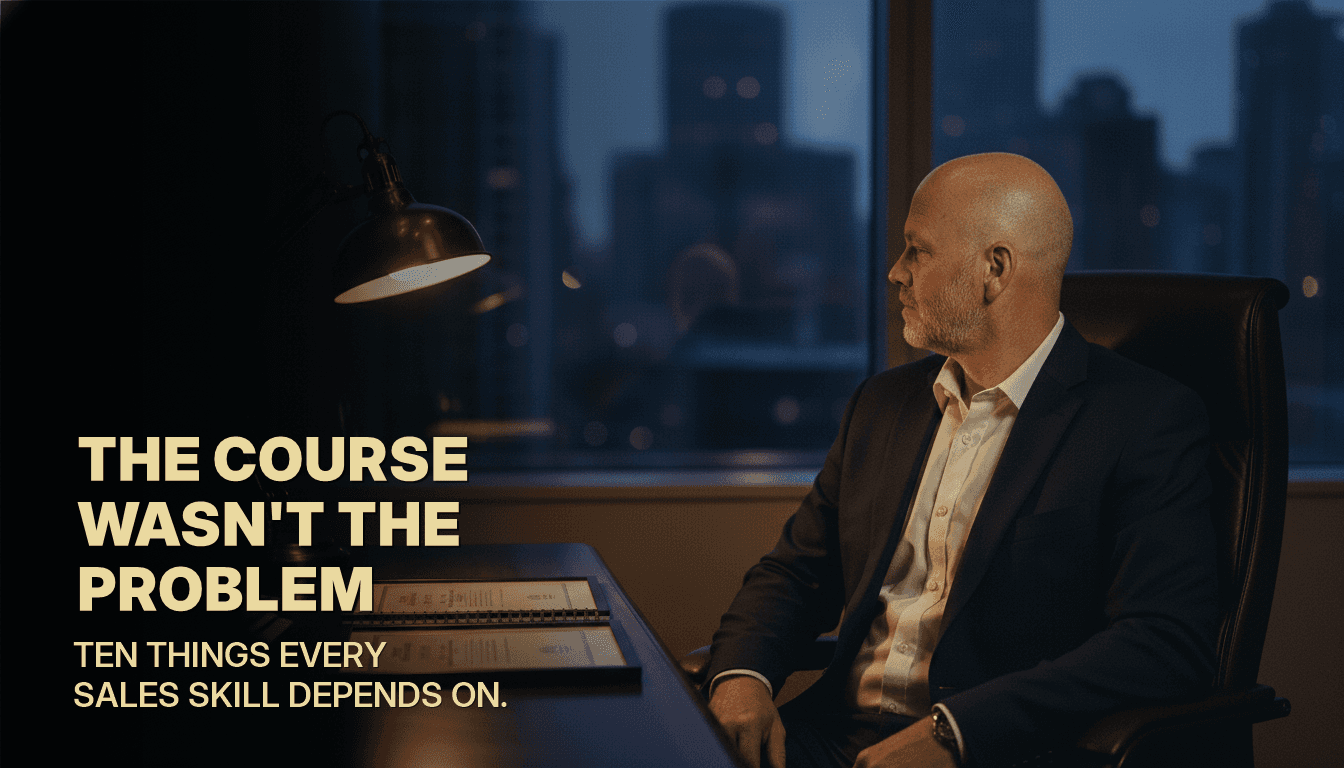

Early in my sales career, I was working harder than I had ever worked. The hours were there. The preparation was there. I showed up to every conversation as ready as I knew how to be.
The results were still not coming.
My manager kept pushing. More challenge. More questions about how I was approaching things. The feedback was hard to hear. There were moments of real frustration where I genuinely did not know what else I could do differently.
I thought I was doing enough. From where I sat, I could see how much effort I was putting in. I could not see why it was not working.
What I could not see was this: I had a fixed picture of myself, and I was using it to filter everything coming at me. Feedback that confirmed the picture got absorbed. Feedback that challenged it got softened or explained away.
I was not doing this deliberately. I genuinely believed I already had a clear enough view of where I stood.
That is the self-sufficiency trap and one of the ten limiting beliefs we measure in MyAcumen.
The belief that quietly holds you back
The self-sufficiency trap is not arrogance. It does not require overconfidence or a lack of care. It is the quiet belief that you already have a clear enough picture of your own strengths and gaps, and that actively seeking external feedback is not particularly necessary.
You know yourself. You have experience. You can work it out.
This belief is especially common in confident, experienced professionals who have built real credibility and a track record. Their experience tells them they know what they know. The problem is that experience without honest reflection tends to reinforce existing patterns rather than surface the blind spots that are limiting the next level of performance.
Harvard Business Review puts the number of truly self-aware professionals at somewhere between ten and fifteen percent. Most of us are walking around with a picture of ourselves that is at least partially inaccurate. Not because we are not thoughtful. Because the gap between how we think we come across and how others actually experience us is almost impossible to see from the inside.
What the trap costs
I eventually stopped defending my picture of myself and started listening. Not because the feedback got easier to hear. Because I ran out of better explanations for why the results were not changing.
I doubled down. I stopped filtering what I was being told and started acting on it. Within twelve months, I was promoted.
I was not dramatically more capable than I had been the year before. I was the same person. What changed was that I stopped treating feedback as something to evaluate against what I already believed, and started treating it as data I could not get any other way.
The cost of the trap is rarely a single dramatic failure. It is years of effort that should be producing more than they are. Promotions you keep coming close to but not getting. Deals you should have won. Performance reviews where the feedback feels vague and you cannot work out why nobody is being more specific.
The compounding effect is real. Korn Ferry studied 486 companies and found that organisations with more self-aware leaders consistently outperformed the market. Poor performers had twenty percent more leaders with significant blind spots. The gap is not small.
Why structured feedback matters more than casual conversation
Most people believe they already get honest feedback. They almost certainly do not.
Colleagues and clients tend to soften, deflect, or assume you already know. Managers often give feedback in the language of intention rather than impact. The result is a feedback environment that feels honest but is mostly polite.
This is why structured 360 feedback matters. When colleagues, customers, and managers respond to specific questions anonymously, you get a different picture from the one you would get from a casual conversation. You see patterns. You see where your view of yourself diverges from how others experience you.
That divergence is where the most important development opportunities live, and it is almost always a surprise.
The most common reaction I see when professionals receive honest 360 feedback is not defensiveness. It is relief. Finally, a picture they can actually work with.
Where to start this week
If you are working hard and not seeing the results you expected, it is worth asking whether you have enough honest external perspective on what is actually happening. Not what you think is happening. What others are experiencing.
Start with one specific question, asked of one specific person. “Do you have any feedback for me?” is too broad to generate anything useful. Try: “What is one thing I could do differently in how I run discovery conversations?” Or: “What is one thing you wish I would stop doing?”
Then listen to the answer without explaining yourself. Just listen. The quality of what you hear will change, and so will your picture of yourself.
You might be doing better than you realise. You might be doing something differently from how you think you are doing it. Either way, you cannot know until you have the data.
Get the complete picture
This is exactly what MyAcumen is built for. The 360 component shows you the gap between how you see yourself and how others actually experience you. Combined with skills, personality, and motivation, it gives you the complete picture in one integrated diagnostic.
£275 for individuals. Or built into the Team Diagnostic for sales leaders who want the same view across the whole group, with the consolidated debrief on top.