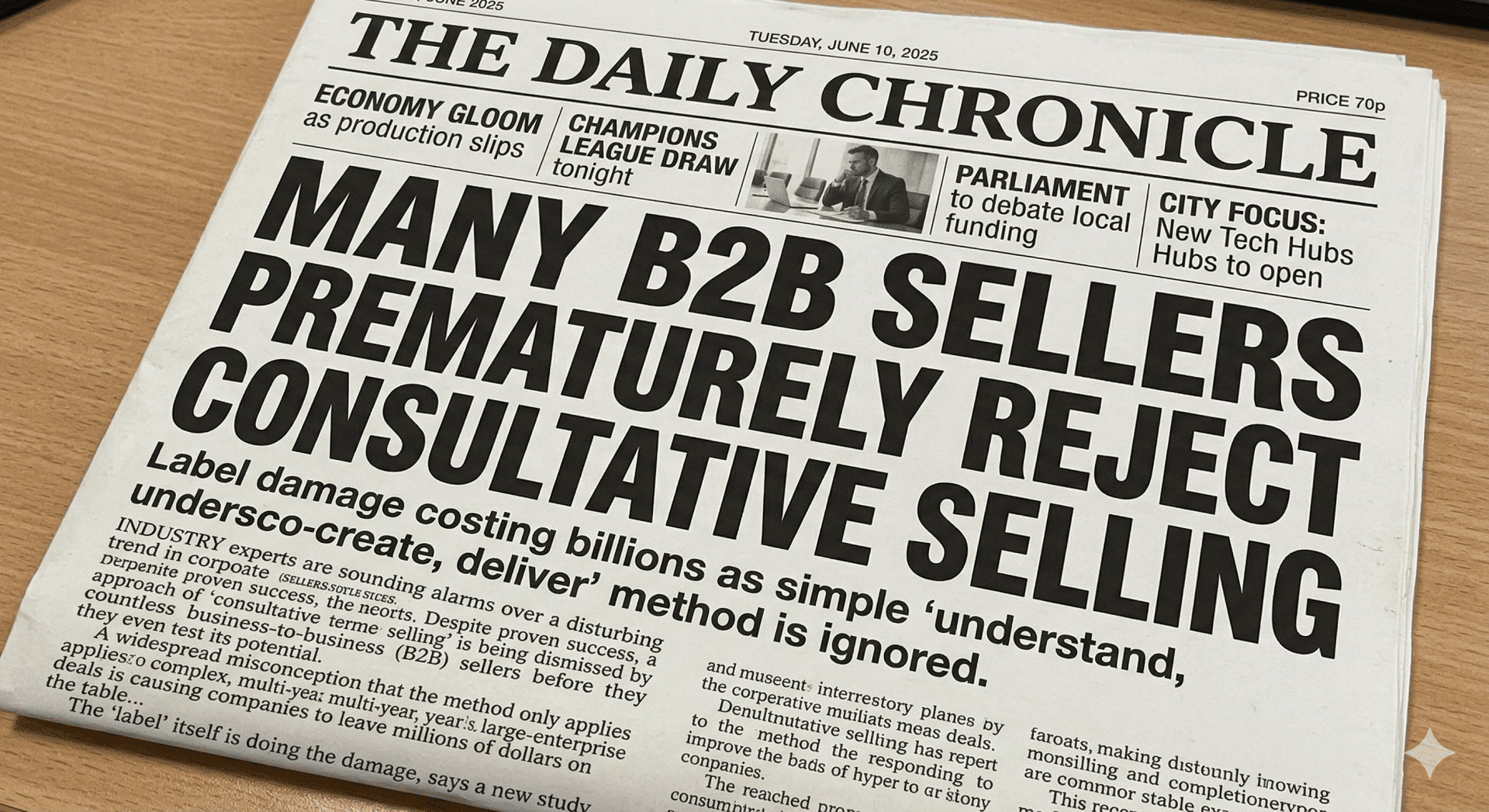

Most B2B sellers have written off consultative selling before they’ve tried it. Not because they’ve tested it and found it wanting. Because they’ve decided it doesn’t apply to them.
The assumption is understandable. The label conjures a particular image: a complex, multi-stakeholder deal with a 12-month sales cycle, a buying committee, and a procurement process that needs its own project manager. If that isn’t your world, consultative selling sounds like someone else’s toolkit.
The assumption is wrong. And it’s costing sellers at every level more than they realise.
The label is doing the damage
Strip away “consultative selling” as a term and what remains is simpler: understand the real problem before pitching the solution. Understand what success looks like for the buyer before talking about your product. Qualify on the business reason behind the purchase, not just the budget and the timeline.
These aren’t enterprise habits. They’re better selling habits. And they work in any B2B environment where the buyer hasn’t already made up their mind before they called you.
The buyer has changed. The pitch hasn’t caught up.
Every B2B buyer, regardless of deal size, arrives at a sales conversation more informed than they were ten years ago. They’ve done the research. They have options. They’ve formed a view before they talk to you.
In that environment, leading with your product doesn’t inform the buyer. It confirms or challenges a view they already have. And if their view was wrong, you’ve just lost the opportunity to help them see it, because you were too busy talking about features to ask what they were actually trying to solve.
The seller who asks one genuine question about the business problem behind the purchase is in a fundamentally different conversation from the one who opens with a product pitch. This is true whether the deal is worth £5,000 or £500,000.
What applying this looks like in practice
I was working with an IoT company, helping them attract new partners to embed their solution into a managed service offer. A potential partner approached us asking for the technical specifications of the solution.
I said no.
Not because the specs were sensitive. Because answering that question would have put us straight into a technical comparison conversation that served nobody well. Instead I challenged them to think differently about what they were actually asking for. I flipped the conversation from technology to business model: how would they use this solution to grow their business? What would their go-to-market look like? What did success actually mean for them commercially?
They were genuinely surprised by the no. Most suppliers would have emailed the spec sheet and waited.
But they engaged fully in the business model discussion. And as a result, they quickly changed their entire go-to-market approach and embedded our solution. Not because the technology was better than the alternatives. Because the conversation had helped them see their own business differently.
The deal wasn’t complex. The sales cycle wasn’t long. But the habit that closed it was consultative: understand the real problem before answering the stated one.
Consultative habits make faster sales cycles faster, not slower
This is the objection worth addressing directly. The assumption is that consultative selling adds time. In practice, the opposite is true.
Discovery doesn’t have to be long. It has to be pointed. One well-prepared question about what the buyer is trying to achieve, and what it costs them not to achieve it, changes everything that follows.
It shortens qualification. You find out faster whether this is a real opportunity or a conversation that goes nowhere.
It reduces objections. When you understand the buyer’s situation before you pitch, your proposal lands in the right context. There’s less to push back on because less has been assumed.
It removes price as the default battleground. When a buyer feels understood, value becomes the frame for the conversation rather than cost. That shift doesn’t require a six-month relationship. It requires one genuine question asked early.
What opting out actually costs
The sellers who decide consultative selling doesn’t apply to them aren’t just missing a technique. They’re leaving the buyer’s real problem on the table, and handing the advantage to whoever asks the question they didn’t.
In any B2B sale where the buyer has a choice, the seller who understands their situation wins more often than the seller who knows their product best. That’s not an enterprise principle. It’s a basic truth about how buyers decide.
The shift is smaller than it sounds
You don’t have to rename what you do or reposition yourself to apply any of this. The habits work regardless of what you call them.
Before your next sales conversation, prepare one question about the business problem behind the purchase. Not a qualifying question designed to move the deal forward. A genuine question about what the buyer is trying to solve, and what it means to them if they don’t.
That’s where it starts, whatever you sell.
______
If you want to understand where your consultative selling capability actually sits, the MyAcumen assessment gives you a specific picture across skills, motivation, personality, and how others experience you. Not a generic benchmark. Start here