
In the mid-1990s, I was part of a focused leadership team in BT Corporate. We were tasked with setting up a team to solve a specific problem in the corporate mid-market. The numbers told a clear story: the revenue-per-head ratio in field sales was difficult to sustain at this level of the market. Cars, expense accounts, the sheer time cost of four visits a day across a territory, the economics didn’t work for accounts below a certain size.
My job on the team was to build the solution for desk and field interaction. I had direct experience across all three models. I’d started my career as a telephone account manager (desk-based, high volume, efficient), then I’d moved through field sales and eventually into global account management. I understood the strengths and limits of each approach.
The task was to design how desk-based and field-based sellers would work together to serve this segment. That meant segmenting the customer base and identify which accounts could be managed remotely, which needed face-to-face presence, and building a model that cut the ‘cost to serve’ without cutting the relationship.
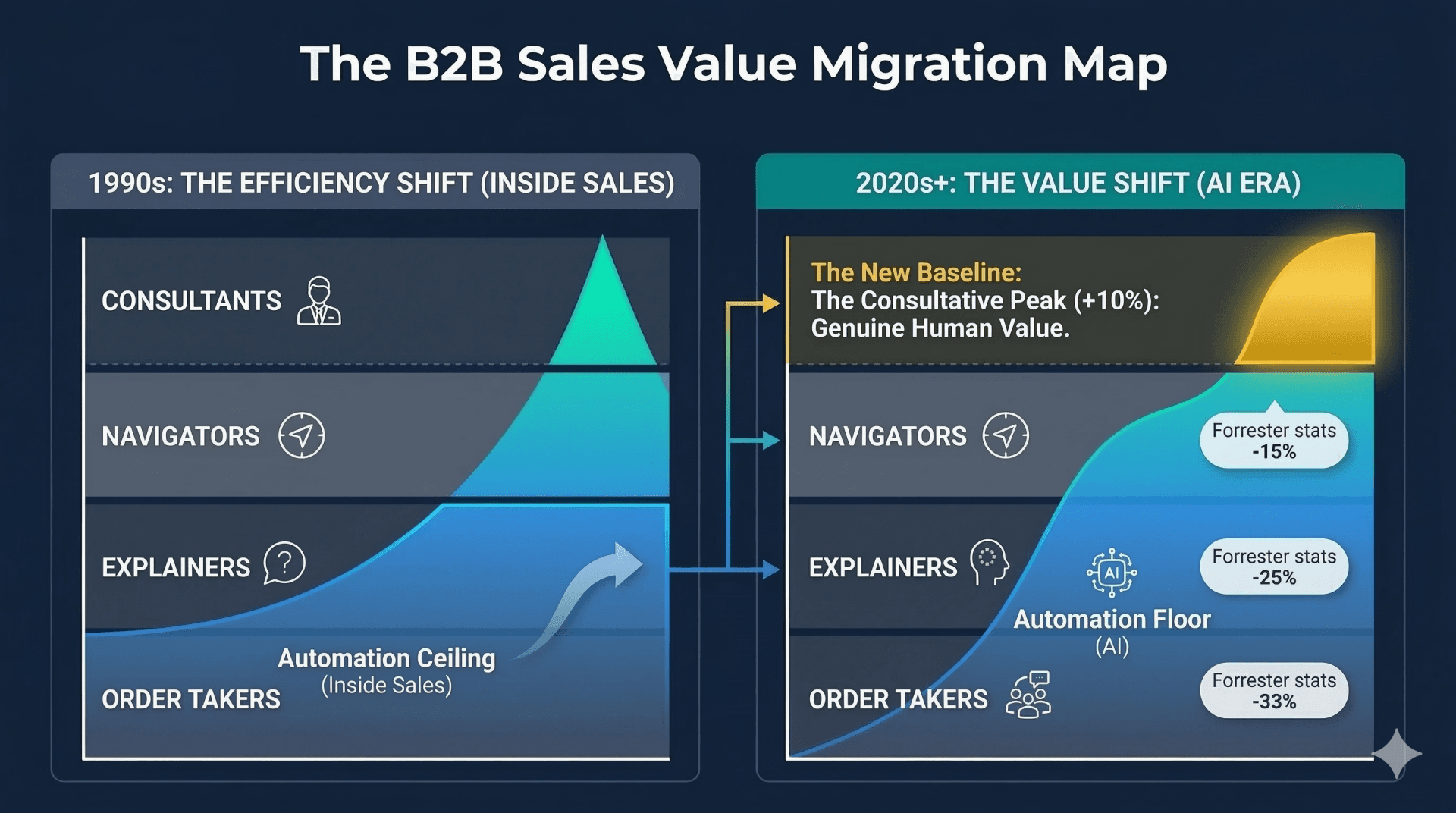
The efficiency case was obvious once you ran the numbers. A desk-based account manager could make at least 20 meaningful customer contacts in a day. A field seller: three or four maximum, but more like one or two. Same customer base. Fraction of the cost. More regular contact for the customer, shorter and less intrusive conversations, and, when it worked, better base coverage.
For smaller accounts and simpler propositions, it worked exactly as intended. The inside sales model spread across the industry through the late 90s and into the 2000s for good reason: the efficiency gains were real.
But we also learned where the ceiling was.
The moment a proposition got complex, the moment we needed to build a multi-year deal, get into a conversation about business outcomes, navigate a procurement process with six stakeholders, or earn credibility with a commercial director who had no patience for product pitches – the desk model ran out of runway.
It could maintain relationships. It couldn’t deepen them in the way that high-value, complex selling required.
Inside sales didn’t replace consultative selling. It clarified what consultative selling was actually for.
The same pattern is repeating today.
In the past week, Atlassian cut roughly 1,600 jobs (10% of their workforce) to fund investment in AI and enterprise sales. CEO Mike Cannon-Brookes put it plainly: it would be disingenuous to pretend AI doesn’t change the mix of skills needed or the number of roles required in certain areas.
This is not a company under pressure. Atlassian had cloud revenue growth above 25% when this decision was made. This is a profitable company deliberately choosing where to put its people and its money. The choice is clear. Automate the efficient stuff. Invest in the consultative stuff.
Block, Salesforce, Oracle have the same logic is playing out across enterprise tech. The pattern is not cost-cutting as a response to weakness. It’s capital reallocation as a response to what the market now rewards.
Forrester called this years ago
Their research mapped four types of B2B seller and modelled what automation would do to each over time. Order takers: -33%. Explainers: -25%. Navigators: -15%. Consultants: +10%.
The direction of travel has been clear for over a decade. What’s changed is the pace. AI is doing efficient far better than inside sales ever could. The roles that desk-based selling displaced in the 90s, including routine customer contact, basic qualification, simple account maintenance is what AI is now displacing. The automation ceiling has moved up. And the floor for what counts as genuinely valuable human selling has moved with it.
The lesson from the 90s
The companies that moved onto inside sales early . The ones that understood the efficiency argument, built an intelligent model combining desk productivity with consultative depth, and positioned their field sellers to focus where it actually mattered, all did well. They maintained customer relationships, reduced cost, and kept growing through the transition.
The ones that resisted got there eventually. But later. And the advantage window had closed by then.
That same dynamic is in motion now. Companies that invest early in genuine consultative capability; the type of seller who can build a credible business case, navigate a complex buying environment, and earn the respect of a senior executive who has no reason to give their time, will build something that compounds. The ones that wait, managing the transition later, will find the window has moved again.
This is not about whether AI replaces salespeople. It won’t replace consultative ones. It will accelerate the pace at which every other type becomes difficult to justify commercially.
What it means right now
If you lead a commercial team, the question isn’t whether to invest in consultative capability. The Forrester data has made that argument for you.
The question is whether you know precisely where your team sits right now, and what specific gaps are holding performance back.
Most sales leaders I work with believe they have a more consultative team than the evidence supports. Not because their people lack intention, but because the gap between wanting to sell consultatively and having the specific capabilities to do it (including business acumen and value case building etc), is wider than most assessments reveal.
Those capabilities are learnable. But targeted development requires an accurate picture first.
The 90s lesson was to move early, segment intelligently, and build for the model that’s coming, not protect the one you’re already running.
That lesson applies now. With more urgency.
Find out where your team actually stands > check out MyAcumen