
The 2026 World Cup kicks off on 11 June. Forty-eight nations. Sixty-four days. One winner.
Every team that walks out has roughly the same raw material: talented players, qualified coaches, and months of preparation. What separates the teams that go deep from the ones that go home early is almost never talent alone.
It is leadership.
And the more time I have spent working with B2B sales leaders over the last eighteen years, the more I notice that the best sales leaders and the best football managers face exactly the same core challenges. Different industry. Different scoreboard. Identical job.
Here is what I mean.
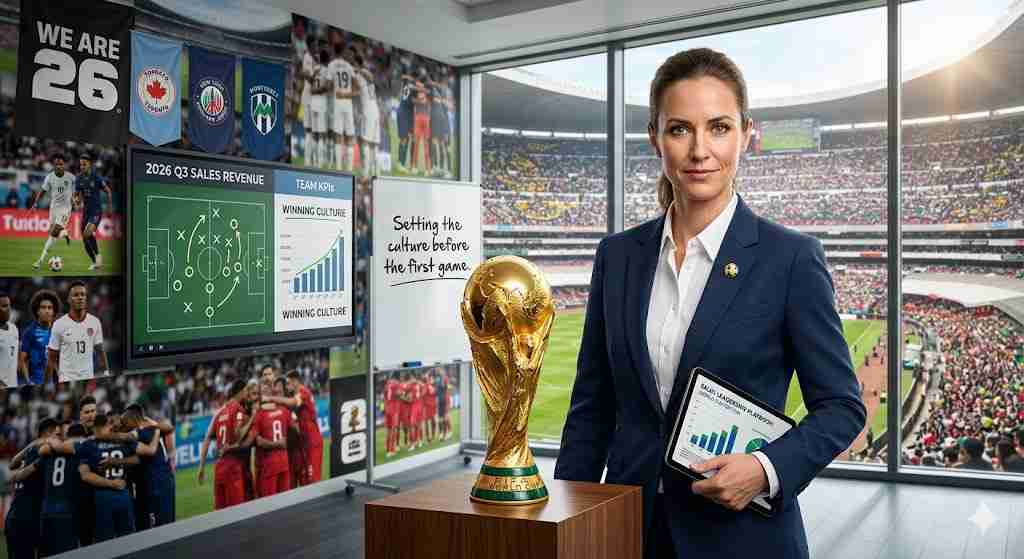
Setting the culture before the first game
Thomas Tuchel took charge of England knowing the squad had developed a habit that was costing them. As he put it, they were playing with a fear of losing rather than a hunger to win. His first job before any tactics, before any team selection, before any preparation for the opposition, was to shift that.
Sales leaders inherit the same problem more often than they realise. A team that has learned to play it safe. To manage the forecast rather than build the pipeline. To avoid the big conversation with a senior stakeholder because they have been burned before.
You can put a new sales methodology in place. You can run a training course. But if the culture is wrong, none of it sticks. The culture tells people what is really expected of them, what will be rewarded, and what will be quietly punished. Tuchel understood that. He called it by name and set about changing it before a single ball was kicked.
That is your job as a sales leader too. Not just setting targets. Setting the tone.
Picking the formation, not just the players
Every World Cup produces a debate about formations. A 4-4-2 versus a 4-2-3-1. A back three versus a back four. Tuchel himself has used multiple systems across England’s qualifying campaign, choosing the shape that fits the opponent rather than defaulting to a single approach.
Sales leaders make the same call, whether they realise it or not. How you structure your team is your formation. Do you have specialists for new business and separate people for account management, or do you expect everyone to hunt and farm? Do you have a sales engineer in the mix, or do you expect your Business Developers to handle technical conversations alone? Have you got a customer success layer protecting and growing existing revenue?
A 4-4-2 worked for a generation of English football. It works less well now because the game has changed. The same is true in B2B commercial environments. The structure that fitted five years ago may not fit the buyers you are selling to today.
Selecting for capability, not just reputation
One of the hardest moments in any manager’s tenure is leaving out a senior player who has always been in the squad. National managers face this every tournament. The player who was brilliant four years ago, who the fans still love, who the rest of the squad looks up to. But who is no longer performing at the level the tournament demands.
Sales leaders face the version of this constantly. The long-tenured rep who has always hit number, but whose approach has not evolved as the market has moved upmarket. The account manager who has great relationships but has stopped growing the accounts. The person who is loyal, likeable, and a fixture, but no longer a fit.
Picking your team on current capability, not historical reputation, is one of the hardest skills in sales leadership. It is also one of the most important. Tuchel was brought in precisely because he would make those calls. The best sales leaders make them too.
Coaching through the tournament, not just before it
Jürgen Klopp was famous for something that often went unnoticed in the coverage of his press conferences and transfer activity. He watched his players obsessively. Not to criticise them, but to understand them. To know which player needed an arm around them before a big game and which one needed a challenge. To spot technical issues in training before they showed up as goals conceded in matches.
The equivalent in sales leadership is the ride-along. Sitting in on calls. Attending customer meetings without taking over. Watching what your people actually do rather than relying on what they tell you they do.
Most of the sales leaders I work with believe they coach their teams. When I ask them how often they are on calls with their people, the number is almost always lower than they think. The game is played in the customer conversations, not the pipeline review.
Half-time adjustments: the ability to read and respond
Pep Guardiola’s ability to adjust at half-time is regularly cited as one of his great strengths. He looks at what is happening, not what his plan said should be happening, and he responds to the actual situation in front of him.
Sales leaders need the same capability. The plan you built in January is rarely the plan you need in June. The market shifts. A competitor moves. A major account changes its leadership. The ability to adapt your approach, your focus, your team structure, without losing the thread of the strategy, is what distinguishes average sales leadership from excellent.
Rigid adherence to a plan that is not working is one of the most common performance problems I see in sales teams. The manager who keeps running the same plays because that is what was agreed, even as the results tell them something needs to change.
The job is the same, the pitch is different
Thomas Tuchel, Pep Guardiola, Carlo Ancelotti. They set culture, choose formations, select for capability, coach through the season, and adapt in real time.
So do the best B2B sales leaders. The pitch is different. The scoreboard measures revenue, not goals. But the job is the same.
If you manage a B2B commercial team and you want to know where your own capability sits across these areas, the Sales Leader assessment at MyAcumen gives you a complete picture: culture, coaching, team development, pipeline management, and more.
Find out where more about your team and what it will take to lead them effectively