
I was working with a technology services company a few years ago. They invested in a boot camp for the sales team to help their team step out of discounts and transactions.
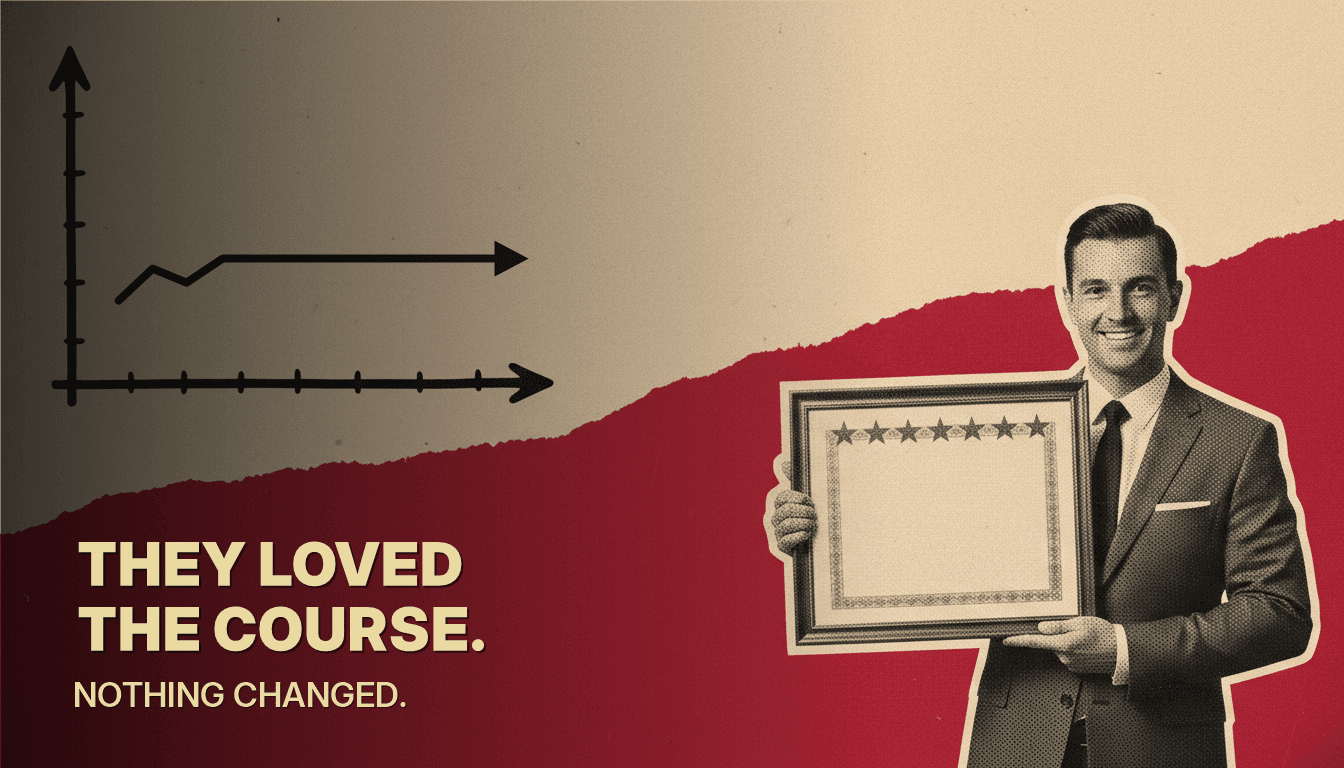
The training sessions spread over five days with work in between and they focused on learning and practising value selling capabilities. The team left the training energised (aren’t they always!), but six weeks later, nothing had changed.
The regular cadence of pipeline and forecast calls were still the same, obsessing about probability estimates, values and close dates. The pipeline reviews were still about data integrity.
The training had effectively been cancelled, though nobody said so out loud.
The training wasn’t the problem. The training was fine.
A shared baseline is a reasonable starting point
Running the whole team through the same methodology isn’t a mistake. It builds a common language. It sets a shared expectation of what good looks like. It gives everyone the same starting point. When you’re launching a new approach, that foundation matters.
The problem isn’t in the training room. It’s what happens when people leave it.
New behaviour doesn’t survive on its own. It needs something to hold it in place. The culture has to make it safe to try. Expectations have to be explicit. Coaching conversations have to reflect the new approach. The things that get praised and questioned in reviews have to signal that this is now how we work.
All of that sits with the sales leader. If none of those things change, the training has a lifespan of about three weeks.
What happens as companies scale
As organisations grow, the pressure from above increases. Forecast accuracy. CRM data integrity. Reporting cadences. Efficiency dashboards. Conference calls with regional directors who need clean numbers before the board sees them.
All legitimate. All important.
But the cumulative effect is that the sales manager’s week fills up with administration. Two forecast calls. A pipeline review. Three updated spreadsheets. A call with a director who wants to understand the Q3 commit. Friday afternoon spent preparing a board update.
When do they coach anyone?
The sales manager has not been promoted into a leadership role. They have been promoted into a senior administrative one, with a leadership title attached. They are not given the authority to make real decisions. They are not trusted to prioritise development over reporting. They are measured on data hygiene and forecast accuracy, not on whether their team is growing and value is created.
So they stop leading. Not through choice. Through structural pressure that makes everything else harder to justify.
And then the organisation wonders why the training didn’t stick.
Process as a substitute for transformation
When real leadership development is hard, organisations reach for process instead.
A new methodology. A CRM update. A training programme. These are visible, auditable, something to point to when the board asks what’s being done. The effort is genuine. The investment is real. But process without leadership behind it is just administration with better branding.
The tech company I mentioned had well defined processes. Clean (but declining and weak) pipeline numbers. Disciplined reporting. And a sales team that reverted to transactional behaviour within six weeks of a value selling boot camp, because the person responsible for reinforcing it had two forecast calls that week and a CRM audit due on Thursday.
The self-awareness gap
Here is the uncomfortable part. Many managers in this position don’t see it.
They are busy (and important!). They are delivering what is being asked of them. In their own mind, they are doing the job. The drift from leader to administrator is gradual. Nobody marks the moment it happened. And honest feedback about it rarely travels upward in a commercial organisation.
A manager who is good at reporting looks effective to the people who receive those reports. Whether the team is actually developing is a harder thing to measure and a less urgent thing to surface.
So the gap widens quietly. The manager commissions training, watches it fail to land, and concludes that the programme wasn’t right, or the timing was wrong, or the team wasn’t ready. They look everywhere except at their own habits and at what they’ve been turned into by the organisation above them.
Research from Korn Ferry across nearly 7,000 leadership assessments found that poor-performing organisations consistently had more leaders with significant blind spots than high-performing ones. Harvard Business Review puts the number of genuinely self-aware professionals at 10 to 15 percent. Sales leaders are not exempt from either finding.
What actually changes this
Two things have to happen together.
The organisation has to give managers back the time and authority to lead. Fewer mandated reporting layers. Fewer calls that could have been a summary email. A clearer expectation that developing people is part of the job, not a bonus activity squeezed in on a Friday afternoon.
And the manager has to honestly assess where they’ve drifted. Not harshly. Clearly. How much of last week was genuine coaching, focused on a specific person and a specific behaviour? How much was administration? Does that ratio reflect what their team actually needs to improve?
The training was never the problem. It rarely is. That’s not to say some training is bad, because sometimes it is badly targeted as a result of limited diagnosis.
The problem is what was or wasn’t waiting for it when the team walked out of the room.
If you’re a sales leader who wants an honest picture of how you’re actually performing across coaching, development, and reinforcement, the MyAcumen assessment gives you that. Not a guess. A complete view across skills, motivation, and how others experience you as a leader.
If you are a sales leader and want to explore your own MyAcumen profile try this, or maybe you have a team and want to assess the whole sales team in a Team diagnostic.