
When looking at the issues associated with consultative selling for sales leaders, many have a lofty ambition for their teams to sell consultatively.
They talk about it in team meetings. They invest in training. They coach on individual deals. And yet, if they’re honest, most of their team is still operating more transactionally than they’d like.
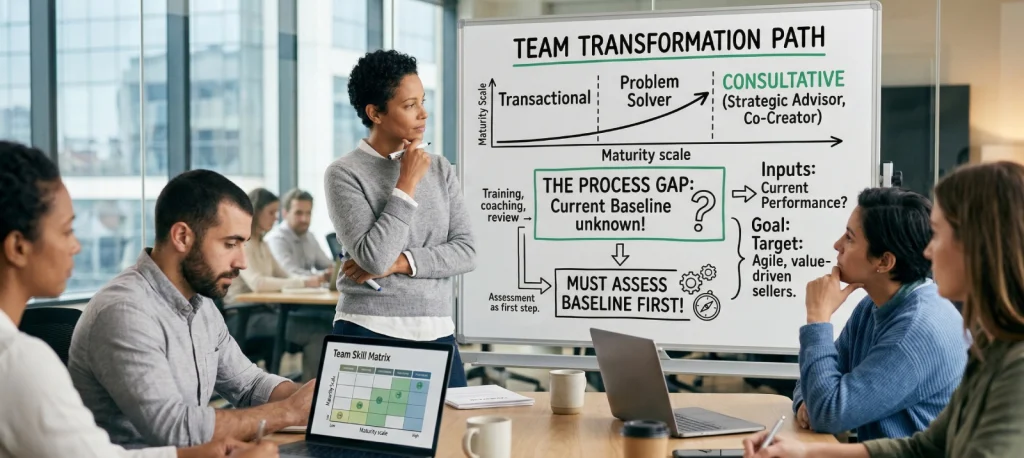
This isn’t a people problem. It’s a process problem. Specifically, it’s the problem of trying to build a consultative sales culture without first knowing where the team actually is.
The gap between intent and reality
Here’s a pattern that’s common across B2B sales teams.
The leader believes they know what consultative selling looks like. They model it in their own conversations. They use the right language, discovery, value, insight, trusted advisor. They coach their team on it after deal reviews.
But the coaching is reactive. It’s based on what went wrong in a specific deal, not on a clear understanding of each person’s capability profile. The training they invest in is generic, the same programme for everyone, regardless of where each individual actually needs to develop.
The result is that the team improves unevenly. Some people respond well. Others go back to doing what they’ve always done. And the leader ends up repeating the same coaching conversations without knowing why they’re not landing. Why this is an issue for sellers.
The root cause is almost always the same: the leader doesn’t have a clear, honest picture of where capability sits across the team. They have opinions, informed ones, but not data.
What a consultative sales team actually requires
Building a consultative sales culture isn’t primarily about training or methodology. It’s about creating the conditions in which consultative selling can take root and compound over time.
Those conditions depend on several things.
1. Knowing where capability actually sits
Before you can develop your team, you need to understand what you’re working with. Not at the level of “Sarah is strong on relationships but weak on commercial conversations”, but at the level of specific competencies, measured honestly across the group.
Where do your best people differ from the rest? Is the gap in discovery quality, commercial acumen, executive presence, or something else? Are the gaps individual, specific to certain people, or do they cluster in ways that tell you something about the team’s collective profile or the types of deals you’re pursuing?
Without this picture, development investment tends to land where it’s least needed, with the people who are already engaged and already performing, rather than where it would make the most difference.
Read more about the various assessments on the market to help
2. Understanding what drives each person
Consultative selling is demanding. It requires sustained effort, genuine curiosity, and a long-term orientation that doesn’t always sit well with short-term sales pressure.
Not everyone on your team will be motivated by the same things. Some people are energised by complex problem-solving. Others are driven by recognition, financial reward, or the quality of their relationships. Some thrive under competitive pressure. Others perform best when they have autonomy and space.
When someone’s motivators are misaligned with what consultative selling demands, or with the environment they’re working in, development efforts often stall. They work hard but not sustainably. They improve in the short term but revert under pressure.
Understanding what drives each person, and whether that’s aligned with your team’s direction, is as important as understanding their skill profile.
3. Knowing how each person comes across
Consultative selling depends on how buyers experience the seller. And that experience is shaped significantly by personality, by natural style, communication patterns, and how each person builds (or inadvertently undermines) trust.
Two salespeople with the same technical skills can land very differently in a senior customer meeting. One comes across as a peer who’s there to help them think. The other comes across as a vendor with a well-rehearsed pitch. The difference often isn’t what they say. It’s the signals they give without realising it.
Understanding your team’s TrustBuilder profiles gives you insight into how each person naturally builds relationships, where they’re likely to create friction they’re not aware of, and how to coach them in ways that work with their natural style rather than against it.
4. Creating genuine accountability
Culture is set by what gets rewarded and what gets let go. If your team sees that short-term results are celebrated regardless of how they were achieved, deals pushed before the customer was ready, relationships burned to hit a quarter, they’ll behave accordingly, regardless of what you say in team meetings.
Building a consultative culture means being consistent about what you value. That includes the deals you don’t celebrate as well as the ones you do. It means coaching on how a conversation went, not just whether the deal progressed. And it means modelling the behaviour yourself, showing your team what consultative selling looks like at the level of leadership, not just in individual deal conversations.
Where to start
The most effective place to start is with an honest diagnostic of where your team’s consultative selling capability actually sits.
Not a training programme. Not a new methodology. A clear, structured picture of each person’s skills, motivators, and style, and how those come together across the team as a whole.
That picture tells you what development will make the biggest difference, for whom, and in what sequence. It gives you a foundation for coaching that’s specific rather than reactive. And it gives your team members something they rarely get: honest, structured feedback on where they are and what they need to develop, not a generic assessment of their personality.
The MyAcumen team diagnostic does exactly this. It covers consultative selling skills, motivators, and TrustBuilder profiles across every member of the team, and gives you a collective view that’s as useful for your coaching as it is for each individual’s development.
Find out more about the MyAcumen Team Diagnostic
Related reading: