
We get asked to compare Consultative Selling vs Solution Selling often.
If you’ve spent any time in B2B sales, you’ve probably encountered both terms. They’re often used interchangeably, sometimes in the same sentence. Most salespeople, if pressed, would struggle to explain the difference clearly.
That’s worth fixing, because the distinction is real, and it affects what you actually do in a customer conversation.
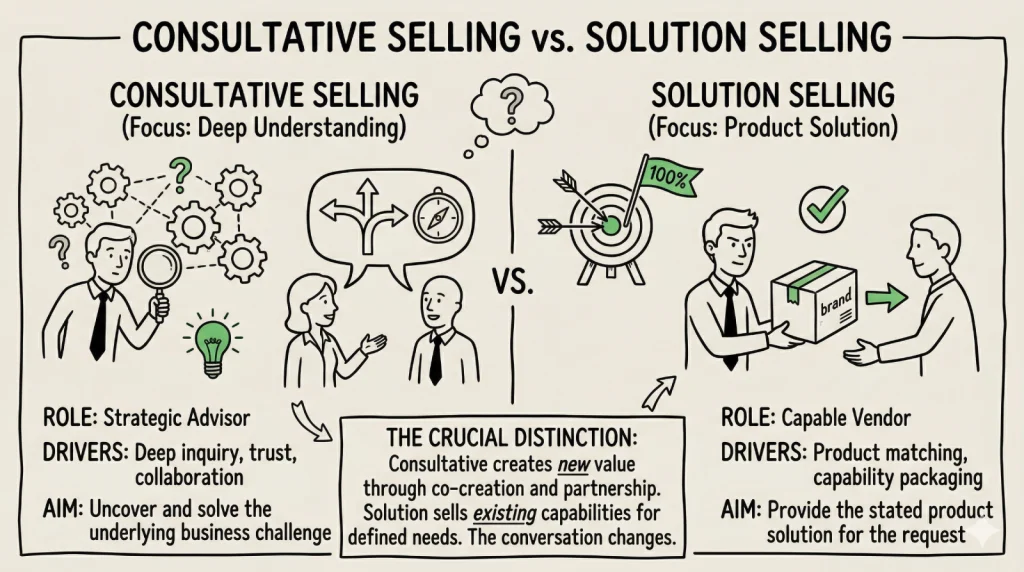
Where the confusion comes from
Both approaches emerged as responses to the same problem: traditional product-led selling wasn’t working well enough in complex B2B environments. Buyers didn’t want to be pitched at. They wanted someone who understood their situation.
Solution selling, developed in the 1980s, was the first widely adopted alternative. Consultative selling came slightly later and overlapped significantly in language and intent. Over time, the terms blurred, partly because consulting firms and training providers used them interchangeably, and partly because the underlying principles do share common ground.
Both involve understanding the customer’s problem. Both involve tailoring what you offer to that problem. Both position the seller as more than just a product vendor.
But there are meaningful differences in emphasis, and in what each approach asks of the seller.
What solution selling focuses on
Solution selling is built around a specific sequence: identify a problem, link that problem to your solution, build a case for why your solution solves it.
At its core, solution selling is product-adjacent. The customer’s problem is the entry point, but the destination was always the solution you have to offer. The discovery process is designed, in part, to qualify whether the customer has a problem your product can solve.
This isn’t cynical. It’s logical. You’re selling something. The question is whether your offering is genuinely the right fit for this customer’s situation.
Solution selling is particularly effective when:
- The problem is already recognised and defined by the customer
- The solution is relatively well-defined and repeatable
- The sales cycle is shorter and the buying committee is smaller
- The decision is largely rational and commercial
What consultative selling adds
Consultative selling starts from a similar place, understanding the customer’s situation, but goes significantly further. (see the full guide here)
Where solution selling asks “what problem do you have that my solution can solve?”, consultative selling asks “what is actually going on in your business, and what would genuinely help?”
The distinction matters because in many complex B2B situations, the customer doesn’t fully understand their own problem yet. They have a presenting issue, the thing they asked about, and an underlying reality that’s often more complicated. A consultative seller helps them see the gap between the two.
This means that consultative selling doesn’t assume your solution is the answer. It’s possible to conduct a genuinely consultative conversation and conclude that you’re not the right fit for this customer at this time. That conclusion might cost you a deal in the short term. It tends to build significantly more trust over the long term.
A few things distinguish consultative selling in practice:
The seller brings a point of view. Not just questions, a genuine perspective on the customer’s business, their market, and the challenges they’re navigating. This elevates the conversation from information-gathering to a genuine exchange of insight.
The problem definition is collaborative. The customer might arrive with a clear view of what they need. A consultative seller doesn’t just accept that view. They explore it, challenge it where appropriate, and help the customer build a more complete picture of their situation.
The time horizon is longer. Solution selling works well when the deal is the primary objective. Consultative selling treats the deal as one moment in an ongoing relationship, and manages it accordingly. Decisions that protect the relationship are sometimes worth more than decisions that protect the quarter.
The seller manages the whole buying picture. In complex B2B deals, multiple stakeholders are involved, each with different priorities, concerns, and definitions of success. A consultative seller doesn’t just manage their main contact. They understand the dynamics of the buying committee and actively help build consensus across it.
Does the distinction matter in practice?
Yes, but not always in the way people expect.
For many sales roles, solution selling is entirely appropriate. If you’re selling a well-defined product into a well-defined problem, and the sales cycle is relatively short, building a complex consultative approach adds unnecessary friction.
Consultative selling becomes more important, and more valuable, as the complexity of the deal increases. When the problem isn’t fully defined, when the buying committee is large, when the sales cycle runs to months or years, when the deal value is significant and the stakes are high for both sides. That’s where the consultative approach creates a genuine commercial advantage.
The clearest signal that you need to develop a more consultative approach is when you start losing deals you expected to win, not because your product was wrong, but because the customer went elsewhere or decided to do nothing. That’s usually a sign that the value wasn’t established clearly enough, the relationship wasn’t deep enough, or the case for change wasn’t compelling enough.
Read more about why the move to consultative selling is important in B2B today
Which approach do you actually use?
Often it’s not Consultative Selling vs Solution Selling at all.
Most salespeople use a blend, and the blend shifts depending on the deal.
The more useful question isn’t “am I a consultative seller or a solution seller?” It’s “for the types of deals I’m pursuing, am I bringing the level of consultative capability they require?”
If you’re operating in complex B2B environments and you’re not sure how consultative your approach really is, an honest assessment of your capability is a better starting point than a methodology debate.
See what assessment options are available for consultative sellers