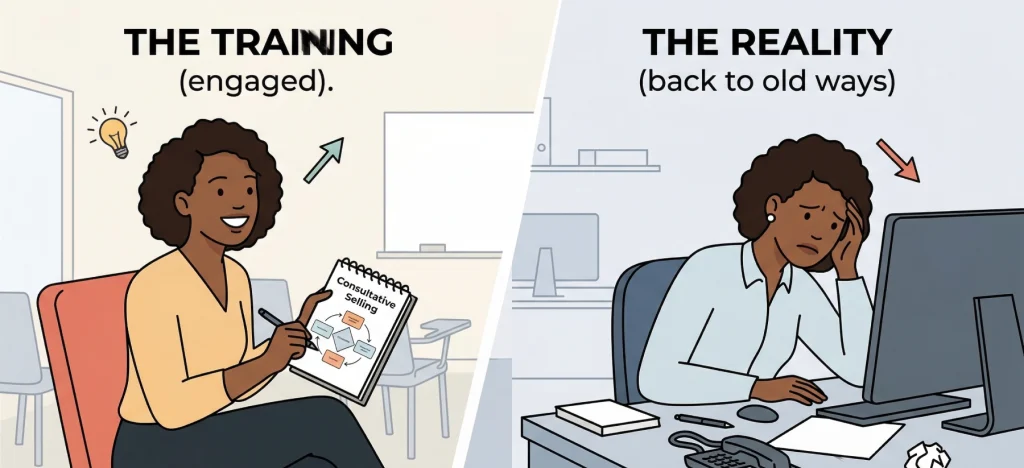
If you’ve attended or taken a consultative selling training course, you probably found it interesting. You picked up some frameworks. You left with good intentions. And then, within a few weeks. You were selling more or less the same way you always had.
This isn’t a reflection on the training. It’s a reflection on how most people approach development, and why the sequence matters more than most people realise.
The problem with starting with training
Most salespeople approach development in a predictable order: find a course, attend it, try to apply what they learned.
The problem is that this skips a critical step. Before you can develop consultative selling skills effectively, you need to know which ones specifically need developing in your case.
This sounds obvious. It rarely happens in practice.
Most people have a vague sense of what they’re good at and what they need to work on. That sense is based on self-perception, which research consistently shows is an unreliable guide to actual capability. Harvard Business Review has estimated that fewer than 15% of professionals are genuinely self-aware about how others experience them. And in sales, the gap between intent and impact is often where the real development opportunities live.
Without a clear, honest picture of where you actually are, training becomes a generic experience. You absorb content broadly rather than developing specific behaviours. You might improve at things you were already reasonable at, and miss the two or three habits that are actually holding you back.
Why consultative selling training is harder than other kinds
Consultative selling isn’t a process you learn once and apply. It requires a set of capabilities that are deeply intertwined with how you naturally think, communicate, and relate to people.
A discovery questioning technique applied mechanically doesn’t work, buyers can tell. A value case built without genuine understanding of the customer’s commercial reality falls flat. Presence with senior stakeholders can’t be faked with a few prepared questions.
This is why off-the-shelf training often produces disappointing results. The content is usually sound. But it assumes a level of self-knowledge and targeted focus that most participants don’t yet have.
The most effective consultative selling development tends to share a few things in common.
1. It starts with honest diagnosis
Before you can develop deliberately, you need to know where you actually are, not where you think you are. That means a structured, honest assessment of your capabilities across the skills that consultative selling demands: discovery depth, commercial understanding, value articulation, executive presence, and the self-awareness that underpins all of them.
Without this baseline, development is guesswork. With it, you can identify the two or three specific behaviours that will make the most difference, and focus there, rather than spreading effort across everything at once.
There are a number of assessment options for you
2. It targets specific behaviours, not general knowledge
The gap between knowing something and doing it consistently is wider than most training programmes acknowledge.
You can understand exactly what good discovery looks like and still conduct shallow discovery in your next ten customer conversations, because old habits reassert themselves under pressure.
What changes behaviour isn’t understanding. It’s deliberate, focused practice of the specific things that need to change, with feedback, repeatedly, until the new habit replaces the old one. A musician doesn’t improve by listening to more concerts. A surgeon doesn’t improve by reading case studies. They practise the specific things they need to get better at.
The same principle applies to consultative selling. Knowing what a great discovery question looks like is step one. Preparing and using one in your next meeting, reflecting on what happened, and adjusting. That’s what builds the capability.
3. It includes external perspective
One of the hardest things about developing consultative selling skills is that the areas where you most need to improve are often the areas where your self-assessment is least reliable.
You don’t know how buyers experience your questions, whether they feel genuinely curious or subtly leading. You don’t know whether your presence in an executive meeting conveys credibility or eagerness. You don’t know whether your discovery conversations are surfacing real insight or just confirming what you already assumed.
Effective development includes feedback from people who can see these things, managers, peers, and ideally the customers themselves. That external perspective is what turns honest assessment into a foundation for genuine change.
What this means if you’re a sales leader
If you’re responsible for developing a consultative sales team, the sequencing issue is even more significant.
Sending your team on a two-day consultative selling workshop before you understand where each person actually is means the investment lands unevenly. The people who needed it most may not recognise what applies to them. The people who needed something more specific may find the content too general. And without a baseline, you have no way to measure whether anything has changed.
The more effective approach is to start with a team diagnostic, an honest picture of where capability sits across the group, where it clusters, and where the most important gaps are. That picture tells you what kind of development will make the biggest difference, and for whom.
It also tells you something about your team’s collective profile: whether the gaps are individual or systemic, whether they reflect the type of deals you’re pursuing, and whether your coaching approach is focused on the right things.
Read more about building your team’s capabilities.
A more effective sequence
The order matters:
- Get an honest picture of where capability actually sits, individual and team level.
- Identify the specific behaviours that will make the most difference for each person.
- Target training, coaching, and practice at those specific behaviours.
- Measure change against the baseline, not against an undefined sense of improvement.
This isn’t a longer or more complicated approach to development. It’s a more honest one. And it’s significantly more likely to produce results that last beyond the immediate afterglow of a good workshop.
For individuals: Take the MyAcumen consultative selling assessment
For teams: Find out about the MyAcumen Team Diagnostic
Or start with something free: take a free mini-assessment
Related reading:
- What is consultative selling? Complete guide
- Consultative selling skills: what they really are
- From transactional to consultative selling