
The pressure on B2B sales professionals has never been higher. Quotas are harder to hit. Buyers are harder to reach. And the role itself is changing in ways that most training programmes haven’t caught up with yet.
This isn’t a temporary cycle. It’s a structural shift, one that’s been building for a decade and is now accelerating fast. And understanding it is the first step to knowing what to do about it.
Here’s the evidence to show why consultative selling is the only way forward for anyone serious about a career in B2B sales.
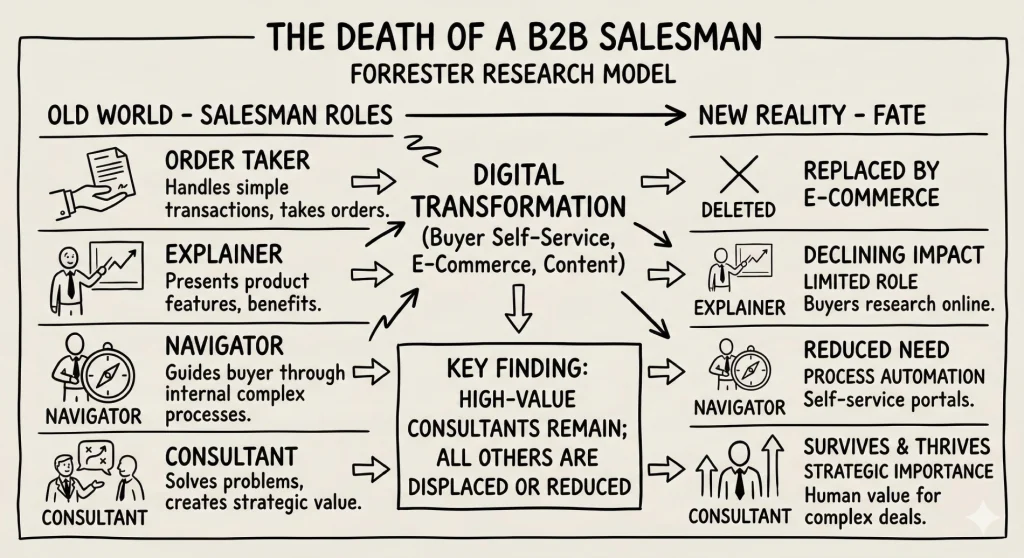
Image adapted from Forrester Research referenced below
Forrester Called It. COVID Proved It. AI Is Finishing the Job.
In 2015, Forrester mapped four types of B2B seller and predicted what would happen to each of them over the following five years. Their data, drawn from US Bureau of Labor Statistics figures tracked from 2012, pointed to one clear conclusion: the sellers who existed primarily to process orders, explain products, or guide buyers through procurement were at serious risk of displacement.
At the time, plenty of people questioned it. And for a few years, they had a point, the shift was real, but gradual enough to argue with.
Then COVID hit.
More than 90% of B2B companies were forced into virtual selling overnight. Digital sales interactions jumped from 48% to 66% of all B2B interactions in a matter of months. Buyers adapted quickly, and discovered they could research, shortlist, and in many cases purchase without involving a salesperson at all. McKinsey’s research found that 80% of B2B buyers had no intention of returning to in-person sales, even after restrictions ended. What had been a slow-moving trend became permanent almost overnight.
And now AI is the second accelerant, particularly for straightforward buying decisions. Forrester’s own data from 2024 shows that 89% of B2B buyers now use generative AI as part of their buying process. Research from 6sense found that by the time a buyer first contacts a seller, they’re already 61% of the way through their decision, with their shortlist set and their budget broadly defined.
Buyers arrive informed. The question is whether the seller in front of them is worth talking to.
Four Seller Types. Three Closing Doors.
Forrester’s 2015 model identified four archetypes. A decade on, the projections are remarkably accurate:
| Seller type | What they do | Projected change |
| Order Taker | Processes orders customers could place themselves | −33% |
| Explainer | Provides information about products and services | −25% |
| Navigator | Helps buyers through procurement and process | −15% |
| Consultant | Solves complex problems the buyer hasn’t fully defined | +10% |
The direction of travel is the same for the first three types: competing with technology that does the same job faster, cheaper, and without the awkward follow-up calls.
- The Order Taker is competing with Amazon.
- The Explainer is competing with a search engine.
- The Navigator is competing with a procurement portal.
The Consultant’s biggest competitor isn’t another vendor, it’s the lack of urgency to change.
And that’s a fundamentally different kind of challenge. One that plays to the strengths of the seller, not against them.
Why AI Makes the Consultative Seller More Valuable, Not Less
Here’s the part most commentary on AI and sales gets wrong.
AI doesn’t threaten the consultative seller. It raises the bar for everyone else, and in doing so, makes the consultative seller more valuable.
Better-informed buyers don’t need less human input. They need higher quality human input. They need someone who gets in early, and helps them see problems they didn’t even know they had.
Done well, consultative selling isn’t a pitch. It’s a diagnosis. A two-way conversation that helps the buyer understand the real cost of their current situation, and what becomes possible if they address it. When that diagnosis lands, and the seller helps to build a case for change, the competition doesn’t get a look in. Because the buyer values the thinking, not just the solution.
Salesforce’s State of Sales research from 2024 captures the gap this creates: 86% of buyers say they are more likely to purchase when a seller genuinely understands their goals. Yet 59% say that sellers don’t bother to understand their business at all.
That gap is where consultative selling lives. And it’s wide open.
The Only Question Worth Asking
If you’re working in B2B sales, the structural argument has already been made for you. The role of the transactional seller (the one who explains, processes, and navigates) is being compressed from every direction. The role of the consultative seller is growing.
The question isn’t which path to take. It’s whether you have the specific capabilities the consultative path requires, and if not, exactly which ones you’re missing.
That starts with an honest picture of where you actually stand.
Read the comprehensive guide to Consultative Selling
→ Get your complete capability assessment here
→ Not sure yet? Start with a free 4-minute mini-assessment here